
In this post7 sections
You cannot edit what happened. You can stop training your brain to relive it.
I have led men in dangerous operations, ministered in many settings, and advised executives and CEOs on complex business decisions. Yet for years, the opponent I couldn’t outmaneuver was locked in my memory.
My brain knew the date on the calendar, but my nervous system still reacted as if the past were happening to me now.
Every time I replay that conversation from the past, the mistake in my life, or that moment from the disagreement I wish I could take back, I do more than remember.
You rehearse it.
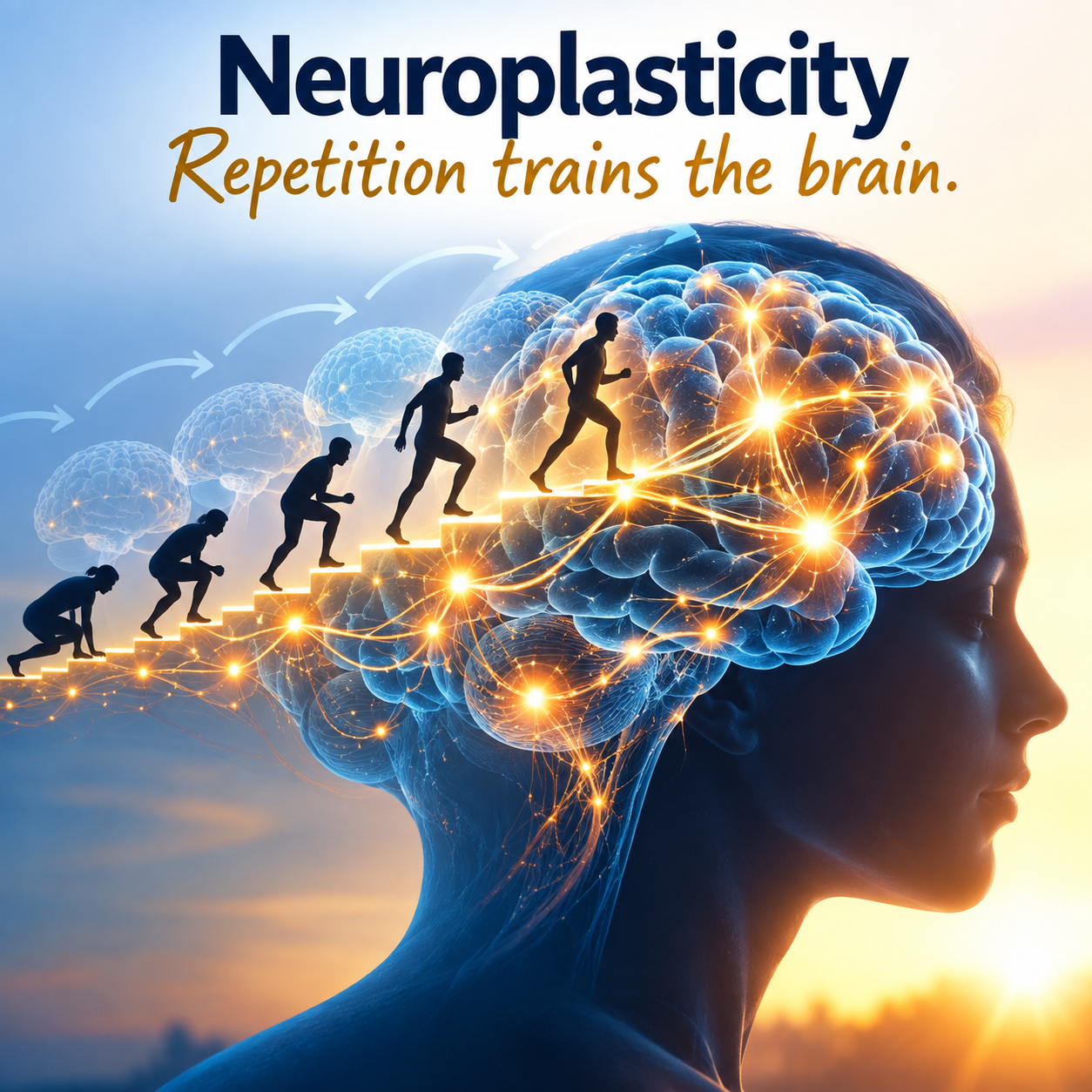
Repetition trains your brain.
Your brain is designed to learn through repetition.
Neuroplasticity.
That’s neuroplasticity: the brain’s ability to adapt, strengthen patterns, and make familiar responses easier to access over time.
Rehearsing fear, shame, regret, and worst-case scenarios can make those pathways feel automatic.
Rehearsing truth, safety, courage, gratitude, and possibility can strengthen a different direction.
Chronic stress also affects the brain systems involved in memory and threat response, which helps explain why old pain can feel so present.
Introduction.
Most people are stuck in the past, not because of what happened. They are stuck because they revisit the past so often.
The argument you replay on the drive home. It’s the text you wish you had never sent. The door that slammed years ago and still echoes when you lie awake.
Your calendar knows the date. Your mind keeps scheduling reruns.
Here is the hope hidden inside the problem: the same capacity that locks the loop in place can unlock it.
This article covers three things: what your brain is doing when you rehearse the past, why willpower alone fails to stop it, and a concrete plan to retrain it.
But first, a confession. I did not learn this in a laboratory. I learned it by losing years to it.
My Story: The Groove I Kept Digging.
In special operations, I was trained to debrief after every mission. I would replay the decisions, identify the failure points, and correct them before the next operation.
It is one of the most valuable disciplines I have learned.
That same discipline also held me captive because my brain was trained and reinforced through daily verbal debriefs.
When I left the military, I carried a decision made under pressure, one that cost more than I cared to admit. I did what I had been trained to do. I debriefed it. Then I debriefed it again. Night after night, year after year, the same mission replayed behind my eyes. The difference was that this debrief never ended in a correction. It only ended in a verdict.
That verdict seeped into everything. When I sensed a call to ministry, the replay answered first:
~ Who are you to lead anyone toward hope?
~ When opportunities opened in business, the same voice warned me I was one decision away from failing people again.
~ When people I loved asked why I would not move forward, I always had an explanation, and it was always the past.
I told myself I was being responsible. In truth, I was rehearsing. I had turned a memory into a training program and was its most dedicated student.
The turning point came from an unlikely place. I was advising a leadership team whose company had stalled for years.
~ Every proposal for change met the same response
~ We tried that once, and it failed.
~ I watched intelligent, capable people defend their paralysis with their history.
~ As I laid out the diagnosis for them, I realized I was describing myself.
That night, I asked a different question. Not what went wrong back then, but what am I training my mind to do now?
The answer was humbling. I had become an expert at reliving the past and a novice at building the future.
The memory did not disappear. It still has a place in my story. But it no longer gets to write the next chapter.
What Your Brain Actually Does With Repetition
The brain is not a video archive. It is a prediction machine that learns from use.
Connections that are activated together often become stronger and easier to activate again.
Neuroscientists call this experience-dependent plasticity.
That principle works in both directions. It is how a surgeon builds precision and how a pilot builds instinct. It is also how a painful memory becomes a well-worn groove the mind slides into without effort.
Psychologists call that groove “rumination.”
It is repetitive, passive dwelling on distress, its causes, and its meaning. Decades of research link it to the onset and persistence of depression and anxiety. The key finding is not that rumination feels unpleasant. It feels like problem-solving while producing no solutions.
One more truth, and it is a hopeful one. Memory is not stored once and left untouched. Each time you recall an event, the memory reactivates and is stored again, shaped by your current state. Researchers call this reconsolidation. You cannot change the event. But how you revisit it influences what the memory carries forward.
A note of honesty belongs here. “Rewiring your brain” is a useful image, not an overnight procedure. Change happens through repetition over weeks and months, just as the old pattern was built.
Why “Just Stop Thinking About It” Fails
If rehearsing the past is the problem, the obvious solution seems to be pushing the thought away. This approach doesn't work, and understanding why is important.
In a well-known series of experiments, psychologist Daniel Wegner asked people not to consider a white bear. They thought about it more, and it returned more often once they stopped trying to suppress it. Suppression requires the mind to keep checking for the forbidden thought, which keeps it active.
This reframes the struggle. You are not weak because the memory keeps returning.
You are rehearsing a pattern, and trying harder to block it is another form of rehearsal.
The exit is not suppression. It is a replacement: providing the brain with different, repeated practice to strengthen instead.
Breaking the Loop: Five Practices
Interrupting a mental loop is less like flipping a switch and more like building a new road until traffic prefers it. These practices are simple. Their power comes from repetition.
Name the loop. When the replay starts, label it: “I am rehearsing again.” Naming shifts you from inside the story to watching it, and choice begins with observation.
Anchor yourself in the present. Say it plainly: “That happened, but it is not happening now.” Then engage your senses: what you see, hear, and feel in this room. The body needs evidence that the threat has passed.
Convert rumination into a question with an action. Ask: “Is there one thing I can do about this situation today?” If yes, do it. If no, the replay has no further work to do, and you can tell it so.
Contain it; do not chase it. Set a short, fixed window to think deliberately about what troubles you, then close it. Worry, when given a time and place, loses its grip on the rest of the day.
Rehearse the replacement. Choose a true statement to practice deliberately and daily, especially when the old loop fires. You are not denying what happened. You are giving your brain new belief parameters to strengthen.
Notice what these share. None requires erasing the past. Each redirects the attention you were already spending on it.
Train Your Mind Toward Truth, Not Trauma
The apostle Paul wrote about this discipline two thousand years before anyone mapped a neuron. In Philippians 3:13-14, he describes forgetting what lies behind and straining toward what lies ahead, pressing on toward the goal.
Read the context, and the passage becomes sharper. Paul had just listed his credentials, pedigree, and record and declared them a loss.
He was not only releasing his failures. He was refusing to let even his past successes define him. For Paul, “forgetting” did not mean amnesia. It meant the past no longer set the direction.
That is the same move science points to. The goal is not to delete memory. The goal is to stop rehearsing the past as though it were the author of what comes next and to rehearse the truth instead: the truth about who you are, whose you are, and where you are going.
The past is part of your story. It is not the author of your future.
A Word of Honesty and a Way Forward
Not every loop is ordinary regret. When memories intrude with the force of reliving them, or when sleep, work, or relationships are breaking down, that is often a signature of trauma.
It deserves more than self-help. Trauma-focused therapies have strong evidence behind them, and seeking that help is an act of strength and stewardship, not a failure of faith.
Your Call to Action: A 30-Day Neuroplasticity Challenge
Your brain is changing whether you direct it or not. The only question is what you are training it to become. For the next 30 days, take control of the training.
Choose one truth. Write a single sentence you will practice in place of the old replay. Example: “That happened. It is not happening now. I am free to build what comes next.”
Catch, name, replace. Every time the loop fires, say “I am rehearsing again,” then speak your truth sentence. Each catch is one repetition of the new pathway.
Pair the truth with an action. Within 24 hours of a replay, take one small step that the old story said you couldn't take. Belief strengthens fastest when behavior confirms it.
Give your brain the conditions to change. Protect your sleep when your brain consolidates what it learned that day, and move your body most days. Regular aerobic exercise supports the biology of plasticity.
Track the reps. Keep a simple tally of catches and actions. Expect the loop to fire often in week one. Watch the gap between trigger and recovery shrink by week four.
Start tonight. Not when you feel ready, and not when the memory fades. The pathway you practice today is the one your brain will choose tomorrow.
Your brain will get better at whatever you keep training. Make it the future.
You can’t edit the past, but you can stop rehearsing it.
MINDSHIFT: Train your mind. Transform your life.
2026 © www.soundthetrumpet.org
Originally published on Substack.