
In this post9 sections
Psychological influence, political polarization, and spiritual discernment
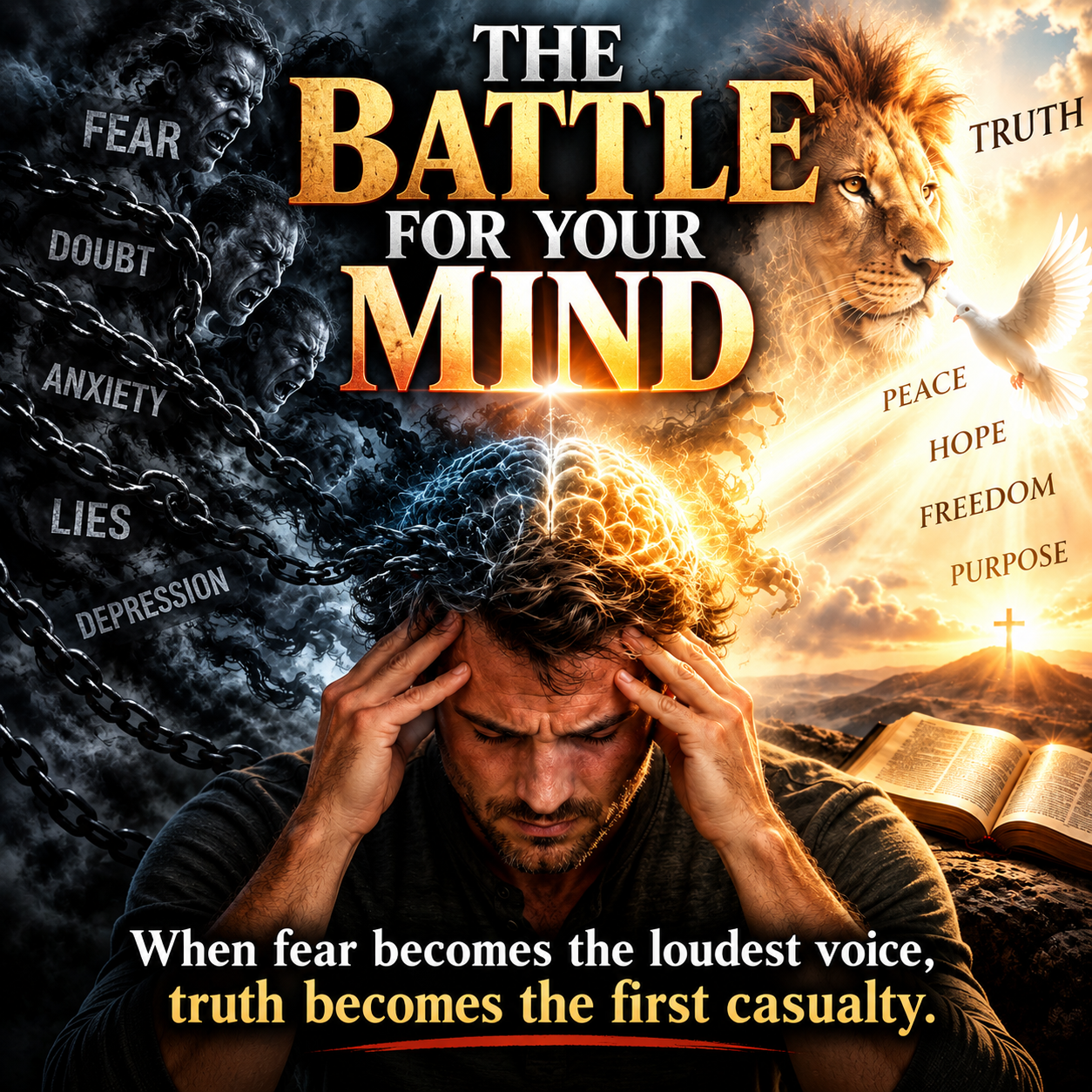
The greatest battle you may face today is not in Washington, on social media, or in the streets. It is in the space between what you hear and what you choose to believe.
That space is small. Often it lasts only a second or two. Yet everything that matters is decided there: how you see your neighbor, how you vote, how you parent, how you pray, and whether you wake up tomorrow with peace or dread.
I know that battle well, because I began fighting it long before I ever wore a uniform.
A Boy and the Voice of Neglect
As a young boy, I fought a battle in my mind every day. No one in my family ever told me I was worthless. They never had to. Their behavior said it for them. I was not valued. I was not important. I was simply there.
Neglect is a quiet teacher, but a relentless one. It does not shout. It repeats. Day after day, the absence of care spoke to me in a language I understood long before I could name it. The message was subliminal, yet loud.
And it bred fear in me. What will happen to me? Where will I go? Who will take care of me?
The more my family showed me I was not loved, the stronger that message grew. The stronger the message grew, the deeper the fear went. Nobody had to convince me of anything. Repetition did the work. My mind was being shaped by what I experienced, not by what was true.
I share this because the mechanism that shaped a neglected child is the same one shaping millions of adults today. The source is different. The method is identical.
Later, in special operations, I learned to name what I had lived through. The most effective way to defeat an opponent is not to destroy his weapons. It is to shape what he believes. Win the mind, and the body follows. Control what a person fears, and you control where he goes.
That principle has not stayed on the battlefield. It now lives in your pocket.
The Architecture of Influence
Every day, you are exposed to a steady stream of messages engineered to provoke a reaction. Headlines are written to alarm. Clips are edited to enrage. Posts are ranked not by truth, but by whether they keep you watching.
This is not an accident. Platforms reward engagement, and nothing drives engagement like fear and anger. Research on social media behavior shows that posts using moral and emotional language spread significantly faster than calm, measured ones. Outrage travels. Nuance does not.
The result is a quiet form of conditioning. No single message changes you. The repetition does. I learned that as a boy at home. Today, an entire culture is learning it through a screen.
What Repeated Fear Does to the Mind
1. Repetition starts to feel like truth.
Psychologists call it the illusory truth effect. The more often we hear a claim, the more believable it feels, even when we once knew it was false. Familiarity masquerades as accuracy. A child told by neglect that he does not matter will believe it, not because it is true, but because it is constant.
2. Fear narrows your vision.
When the brain detects threat, the amygdala takes the wheel. Attention shifts toward survival and away from the prefrontal cortex, the region responsible for reasoning, patience, and perspective. In that state, you are built to react, not to reflect. That served our ancestors well against predators. It serves us poorly against a headline.
3. Bias hardens into identity.
Once fear attaches to a group, a party, or a cause, information stops being something we evaluate and becomes something we defend. We seek what confirms us and dismiss what challenges us. The other side is no longer wrong. They are dangerous.
4. Decisions get made in the wrong room.
A mind saturated with alarm makes choices from scarcity and suspicion. Relationships fracture. Families stop speaking. Congregations divide. People make financial, medical, and moral decisions not from wisdom, but from the last thing that frightened them.
Those who have lived with trauma will recognize this pattern. The alarm system that once protected you can keep sounding long after the danger has passed. A culture that feeds on fear produces the same condition in people who have never seen combat: a nervous system permanently on watch, mistaking noise for threat.
The Spiritual Front Line
The psychology explains the mechanism. Scripture names the battle.
“And be not conformed to this world: but be ye transformed by the renewing of your mind, that ye may prove what that good, and acceptable, and perfect, will of God is.”
Romans 12:2
Conformity happens to you. Transformation happens through you. The world does not need your permission to shape your thinking. It only needs your inattention. Renewal is a deliberate act. It requires you to guard what comes in.
“For God hath not given us the spirit of fear; but of power, and of love, and of a sound mind.”
2 Timothy 1:7
Fear has a source, and it is not God. That truth gives you a diagnostic tool. When a message leaves you anxious, contemptuous, and hopeless, you are entitled to ask where it came from. What God gives produces power instead of helplessness, love instead of hostility, and a sound mind instead of a scattered one. The fruit reveals the root.
“Casting down imaginations, and every high thing that exalted itself against the knowledge of God, and bringing into captivity every thought to the obedience of Christ.”
2 Corinthians 10:5
This is military language. Thoughts are not simply experienced. They are captured, interrogated, and brought under authority. You are not obligated to host every idea that knocks on your door. You are called to take it into custody and examine its credentials.
Reacting From Fear
A reaction is fast. It happens before you have decided anything. A headline hits, the chest tightens, and the response is already underway. You share before you verify. You judge before you understand. You pick a side before you know what the fight is about.
Fear always needs a target. It looks for someone to blame because blame feels like control. In that moment, the person across the aisle, across the table, or across the street stops being a person. They become the threat your mind has been trained to expect.
I recognize this pattern because I lived it as a child. Fear did not ask whether the message of neglect was true. It simply accepted it and built on it. Each new disappointment confirmed the old belief, and each confirmation strengthened the fear. That is how reaction works. It does not examine. It accumulates.
The cost is high. A reactive mind is exhausted. It is always braced, always scanning, always one notification away from agitation. It mistakes intensity for importance and volume for truth. And it leaves you drained, suspicious, and strangely lonely, even when surrounded by people who agree with you.
Most dangerous of all, a reactive person is easy to steer. Whoever controls your fear controls where you go. You believe you are thinking for yourself, but you are following a script someone else wrote. Reaction feels like strength. It is surrender.
Responding Through Faith
A response is different. It begins with a pause. In that pause, you reclaim the space between what you hear and what you choose to believe. You stop being a target and become a gatekeeper.
Faith does not ignore the facts. It looks at them squarely. It acknowledges injustice, danger, and uncertainty without letting fear write the conclusion. Faith asks better questions. What is true here? What is missing? What does God say about this? What would love require of me?
Where fear seeks someone to blame, faith seeks what is true. Where fear sees enemies, faith sees people, many of them as frightened and manipulated as we are. Where fear rushes to share, faith is willing to verify first or stay silent.
This is not passivity. Responding through faith takes more discipline than reacting ever will. It requires you to sit with discomfort long enough for wisdom to speak. It requires humility to admit you may not have the whole picture.
For years, the voice of neglect told me I did not matter. The voice of truth answered it. That is the work of renewal. One message, held against what God has said, can be exposed, captured, and replaced.
The fruit of a faith response is unmistakable. You remain anchored when others are shaken. You see clearly when others are blinded by alarm. You carry a peace no headline can give, and no algorithm can take away.
Guarding the Gate: Five Questions Before You Believe
When a message lands hard, run it through these five checkpoints before letting it take root.
~ Who benefits if I believe this? Every message has a sender, and every sender has an interest. Ask what they gain from your outrage.
~ What am I feeling right now? Name the emotion. Fear and anger signal you to slow down, not to speed up.
~ Is this the whole picture? A clip, a quote, or a statistic stripped of context can tell a false story.
~ Does this align with what God has said? Hold it against Scripture and the character of Christ. Truth doesn't require you to hate it.
~ What fruit will this produce in me? If believing it makes you more fearful, more bitter, and less loving, treat it with suspicion.
This takes seconds. Over a lifetime, those seconds become a fortress.
Taking Back Lost Ground
You cannot control every voice in the world. You can control which ones you invite into your head.
~ Ration your intake. Limit news and social media to set times. A mind that never rests from alarm cannot hear anything else.
~ Feed before you consume. Start the day with Scripture and prayer before you turn on a screen. Let truth set the baseline.
~ Diversify your sources. If every voice you hear agrees with you, you are not informed. You are insulated.
~ Restore real relationships. Have the conversation face-to-face. People are rarely as monstrous in person as they appear in a comment section.
~ Practice stillness. “Be still and know” is not a suggestion for the calm. It is a command for the besieged.
The Question That Remains
Every thought you entertain casts a vote for the person you are becoming.
The boy who believed he didn't matter wasn't lying to himself. He was listening to the loudest voice in the room. Many of us are doing the same today.
So the question is not whether your mind is being influenced. It is. The question is by whom.
Fear will always be loud. It shouts, repeats, and demands an immediate reaction. Truth is often quieter. It waits in the space between what you hear and what you choose to believe.
Guard that space. It is holy ground and the front line.
Reflection for this week:
~ Which voice has had the most influence on your mind over the past seven days?
~ What belief have you held for years that stems from fear rather than truth?
~ What would change if you brought that thought into captivity this week?
Dr. Ronald Campbell, PsyD, ThD
2026© www.soundthetrumpet.org
Originally published on Substack.