
You built your life on what you believe.
The silent filter is costing executives their next level of growth
Years ago, I worked closely with a sharp, well-resourced entrepreneur. He was articulate and confident, and he had built something genuinely impressive. But he had a habit that quietly became his ceiling. Whenever a market shift, a team member, or a trusted advisor brought him information that did not match what he already believed, he dismissed it without investigation. “I’ve been in this industry long enough to know what’s real,” he would say.
He was not arrogant in the obvious sense; he was simply confident, and that confidence colored everything he did. He turned down an emerging platform in his industry because it didn’t align with his view of how things should work.
He lost two of his best employees because he couldn’t hear what they were saying about the culture. He remained loyal to a strategy long after the data suggested he should change course.
By the time he was willing to listen, the window had narrowed considerably.
He was not a poor leader. He was a leader running on an old program he did not know he had. His mind was not processing the world as it was. It was processing the world as he had decided it would always be.
That story is more common in executive circles than anyone admits. And the reason it keeps repeating has a name.
Every leader reading this has decided this week, not based on data but on what they already believed was true.
Not because they are careless. Because they are human. And the human brain was not designed for objectivity. It was designed for survival. That distinction is costing businesses millions and costing leaders the very wisdom they need to lead well.
There are two forces operating beneath every meeting you run, every hire you make, and every strategy you approve. One is neurological. One is as old as Scripture. Together, they either open your future or silently seal it shut.
The Filter Running Your Business Without Your Permission
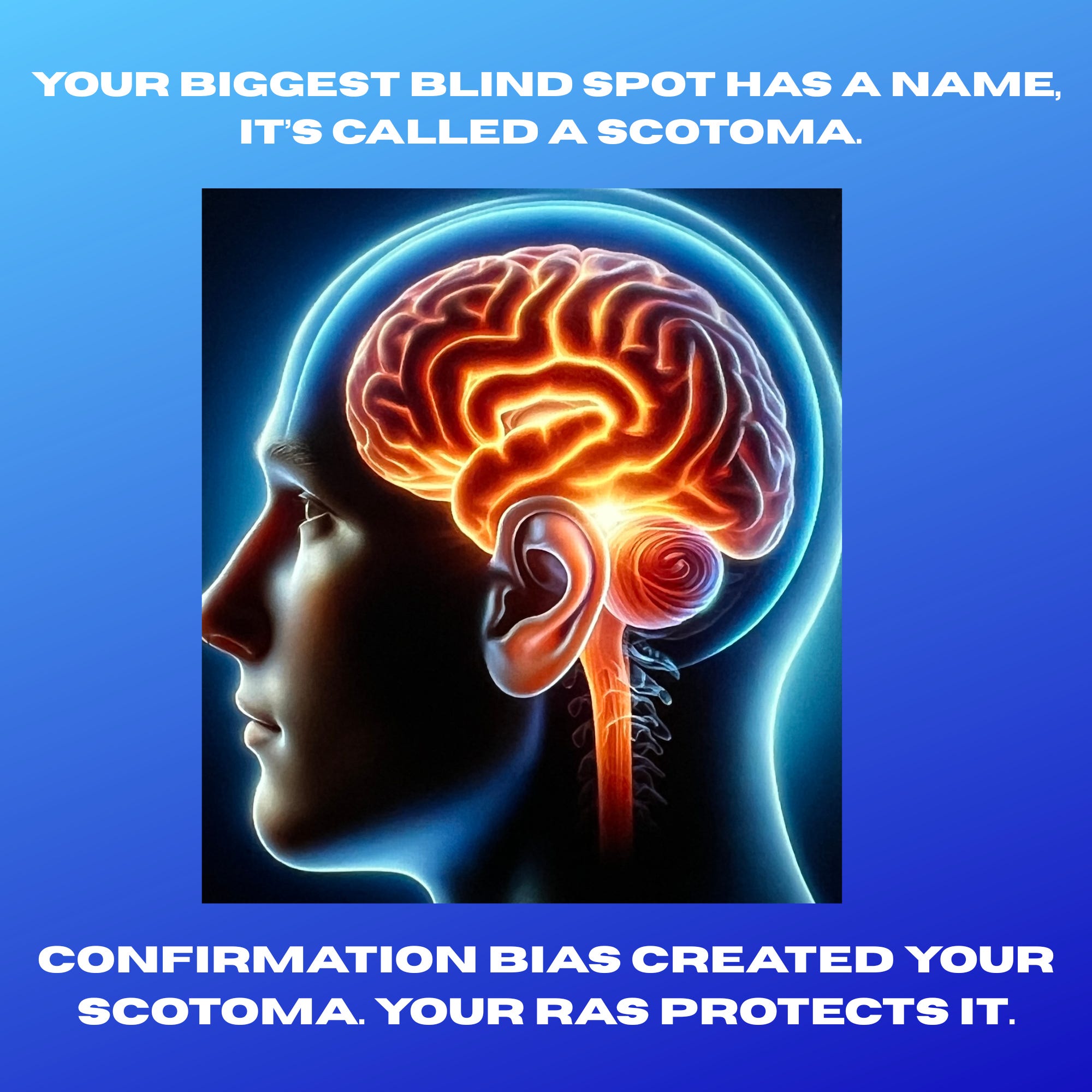
Deep in the brainstem sits a neural network called the Reticular Activating System, the RAS. Every second, your senses deliver roughly 11 million bits of information to your brain. Your conscious mind processes about 50 of those bits.
The RAS decides which 50 make it through.
It does not filter for accuracy. It filters for consistency. It surfaces what already matches the story you have decided is true and quietly buries everything else.
This is why two executives in the same meeting can walk out with completely different readings of what just happened. Their filters are different. Their histories are different. Their priors are different. And their RAS is loyally protecting each of them from information that would disturb the pattern.
If you believe your market is shrinking, your RAS will find you proof of that every single day.
If you believe a certain type of person cannot lead, your RAS will hand you evidence every time you look.
If you believe you have already figured out what works, your RAS will protect that belief from every challenge that walks into your office.
You are not seeing the truth. You are seeing a highly personalized confirmation of what you already decided was the truth. And you are making seven-figure decisions from inside that filter.
Confirmation Bias: The Invisible Advisor in Every Executive Decision
In 1960, psychologist Peter Wason ran a deceptively simple experiment. He gave participants the number sequence 2, 4, 6 and asked them to determine the underlying rule. Participants could test any sequences they wanted before guessing.
Nearly every participant tested sequences that confirmed what they already suspected. Sequences like 8, 10, 12. Like 20, 40, 60. And when those tests came back correct, they declared they had found the rule.
Almost nobody tested a sequence designed to break their hypothesis.
The actual rule was simply three ascending numbers. Any three ascending numbers. 1, 2, 3 would have worked. So would 7, 51, 10,000.
But the participants were not trying to find the truth. They were trying to confirm what they already believed. And the data cooperated just enough to let them feel certain while remaining completely wrong.
That experiment was conducted 65 years ago. The boardroom version of it is running in your organization right now.
Why the Smartest Leaders Stay Wrong the Longest
Here is the uncomfortable reality that neuroscience has confirmed: intelligence does not protect against confirmation bias. It amplifies it.
Highly capable minds are extraordinarily efficient at building sophisticated arguments for positions they have already emotionally committed to. The more skilled you are at analysis, the better you are at making wrong conclusions sound airtight.
When someone challenges a belief you hold with conviction, your amygdala, the brain’s threat-detection system, fires as if the challenge is a physical attack. Cortisol rises. Strategic thinking narrows. You shift from “What is this person seeing that I’m not?” to “How do I defend my position?”
Your brain cannot distinguish between a threat to your body and a threat to your identity. Both register as danger.
This is why talented, experienced, high-performing leaders can become the most difficult people to reach with a new idea. Their very competence becomes the wall that keeps growth out.
The Ancient Warning That Predates Every Business School
Long before neuroscience gave this a name, wisdom literature diagnosed the same disease.
“He who answers a matter before he hears it, it is folly and shame to him.” Proverbs 18:13
“Be quick to listen, slow to speak, and slow to become angry.” James 1:19
The prophetic tradition has always understood something that modern leadership culture resists: the most dangerous person in any room is the one who has already decided. Certainty that is not grounded in continuous inquiry is not wisdom. It is pride dressed in the language of experience.
The leaders Scripture celebrates are not the ones who were always right. They are the ones who remained teachable when being wrong was costly. Joseph interpreted what he did not yet understand. Solomon asked for wisdom rather than assuming he already had it. Daniel continued to seek clarity even when he held power.
Every great leader in the biblical record had one thing in common: they stayed open when it would have been easier to close.
That is not weakness in an executive. That is the rarest form of strength.
What This Is Actually Costing You
Consider what confirmation bias looks like inside a business:
You hire people who think like you because they feel right, and build a team with one perspective dressed in twelve different faces.
You dismiss a competitor’s move as irrelevant because it does not fit your model of how the market works, until it takes your market share.
You ignore internal feedback from your team because it conflicts with your read of the culture.
You double down on a failing strategy because abandoning it would mean admitting the original decision was wrong.
None of this is malicious. All of it is expensive.
The RAS is not your enemy. It is a tool. But right now, for most executives, it is running on old programming, built from past wins, past wounds, and inherited assumptions, and it is filtering your present through the lens of a world that no longer exists.
Reprogramming the Filter: Practical Steps for the Executive Leader
Rewiring the RAS is not a matter of motivation. It is a matter of deliberate practice. Here is what that looks like at a leadership level:
Stop before you respond. When an idea triggers resistance, pause before speaking. That resistance is information. Ask what the feeling is protecting before you allow it to run the meeting.
Require the strongest version of the opposing view. Before your team debates any strategy, require someone to present the best possible case for the opposite position. If you cannot state the counterargument fairly and completely, you do not yet understand the issue well enough to decide.
Separate identity from position. Your worth as a leader is not attached to whether your last call was right. Changing your mind when the evidence changes is not a weakness. It is the mark of someone who leads from truth rather than ego.
Diversify your input intentionally. Not to be swayed by everyone. To stress-test what you already believe. The belief that survives contact with its strongest challenge deserves to survive. The one that did not just save you from a very expensive mistake.
Create a culture that rewards being wrong early. The organizations that outperform are not those in which the leader is always right. They are the ones where truth surfaces fast because people are safe enough to tell it.
The Prophetic Principle Behind All of It
There is a reason the prophetic voice in Scripture always began with “Hear.” Not “agree.” Not “comply.” Hear.
The capacity to hear without defending is not a soft skill. It is a spiritual discipline. It requires the humility to hold your current understanding loosely enough that truth can do its work.
Growth, in business as in life, does not come to the person who is the most certain. It comes to the person who is the most honest about what they do not yet know.
The RAS will give you whatever world you tell it to find. The question facing every leader reading this is the same question it has always been:
Are you brave enough to ask for the true world, even when the true world requires you to change?
That is where the next level begins. Not in a new strategy. Not in a new market. In a new willingness to hear.
Before You Close This Tab
If this article confirmed something you have been sensing but could not name, share it with one person in your network who leads at a high level and needs this conversation.
And if you want more thinking like this, thinking that sits at the intersection of deep wisdom, human behavior, and executive performance, subscribe. There is more where this came from.
Dr. Ronald Campbell, Consultant, author, and futurist, helping executives expand awareness, align belief with truth, and lead with wisdom and integrity.
2026 (C) www.soundthetrumpet.org
