Prophetic Patterns of Pride, Power, and Chaos in a Narrow Strait.
Leviathan Rising: The King of Pride
“Pride goeth before destruction, and a haughty spirit before a fall.”
Proverbs 16:18
Something is moving beneath the surface of our age, and most people feel it long before they can name it. Markets twitch at rumors of conflict in narrow seas. Politicians speak with growing confidence and diminishing wisdom. Headlines contradict themselves within hours. A quiet anxiety has settled over nations, an unease no commentator can fully explain because the cause is not primarily political.
It is spiritual.
Most modern minds are trained to dismiss such language. We have been taught to interpret history through economics, ideology, and policy alone. Those lenses are useful, but they are incomplete. They can describe how things move, but they cannot explain why so many separate movements bend in the same direction at the same time. For that, we need a different kind of sight, the kind Scripture gave to prophets long before it was fashionable to be one.
Scripture gives this disturbance a name. Job called him the king over all the children of pride. Isaiah called him the twisting serpent in the sea. We know him as Leviathan, and his fingerprints are on more of our current chaos than most care to admit.
This is not a myth. It is a pattern, and the pattern is escalating.
The King Over the Children of Pride
Job 41 closes with a line that should make every reader pause. “He beholds every high thing; he is king over all the children of pride.”
Isaiah sharpens the image.
“In that day the LORD, with his sore, great, and strong sword, shall punish Leviathan, the piercing serpent, even Leviathan, that crooked serpent; and he shall slay the dragon that is in the sea” (Isaiah 27:1).
In plain biblical terms, what we are looking at is a spiritual force whose throne is established wherever pride is welcomed. Leviathan is not merely a metaphor for the proud. He is the ruler over the proud, the unseen authority that gathers strength wherever men exalt their own opinions above the wisdom of God.
Pride is his domain. In Scripture’s symbolic language, water is often his stage. When both rise together in a single moment of history, we are not witnessing a coincidence. We are witnessing a convergence.
Battles at Sea and the Prophetic Stage
In Daniel 7, the prophet sees four beasts rise from “the great sea,” each a kingdom drunk on its own dominion. In Revelation 13, John watches another beast rise from the sea, blasphemy on its lips, and nations under its sway. Throughout the prophetic literature, the sea represents the restless mass of humanity, the chaos of nations apart from God, and the womb of empires.
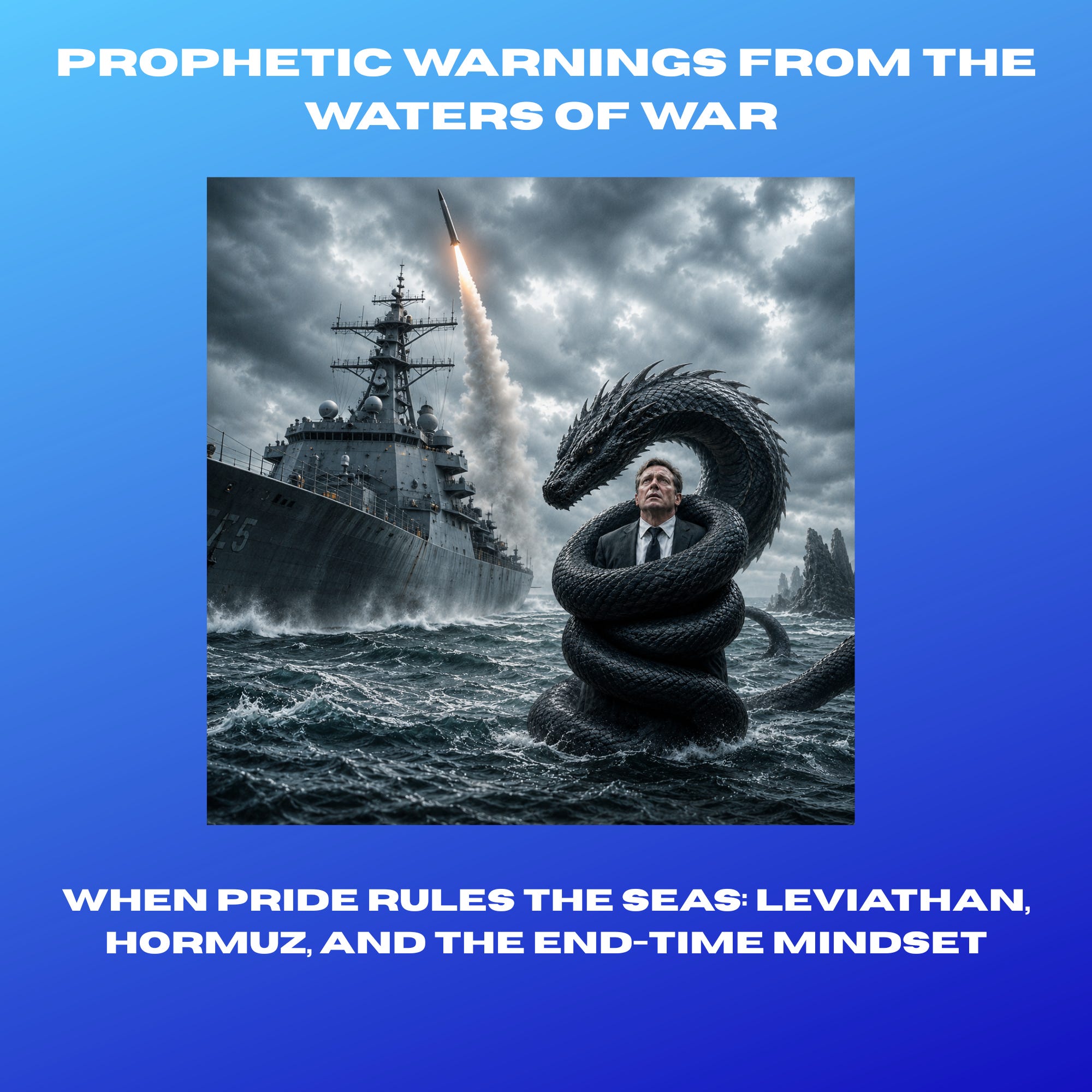
When global tensions concentrate in waterways such as the Hormuz Strait, the Red Sea corridors, the South China Sea, and the Black Sea, we should not be surprised. These are precisely the places Scripture prepared us to watch. They are gates. They are pressure points where pride and power meet in a confined space. They are stages on which the spirit of Leviathan finds its most natural theater.
Roughly a fifth of the world’s oil flows through Hormuz. Nearly a third of global container shipping passes through the South China Sea. These are not merely trade routes. They are spiritual choke points where the king of pride loves to gather his children and watch them posture against one another.
This is not a new pattern. From the moment Pharaoh’s chariots pursued Israel into the Red Sea, the great waters have served as the scene of human pride and divine judgment. Empires have been built on naval supremacy and broken in narrow channels. The warship has always been a symbol that pride takes seriously, because nothing flatters the proud heart quite like power displayed on water.
Revelation ends with a startling promise.
“And there was no more sea” (Revelation 21:1).
The chaos ends. The dragon is defeated. But not yet. Until that day, the waters churn, and we are wise to read them with prophetic eyes.
Failed Leadership as Leviathan’s Workshop
Pharaoh is the great Old Testament case study. Plague after plague, warning after warning, his heart hardens. Each refusal locks him deeper in ruin. Pride does not announce itself. It disguises itself as resolve, as strength, as the refusal to appear weak.
King Saul tells the same story in another key. Anointed by God, lifted to the throne by Samuel, and slowly hollowed out by his own jealousy and fear. By the end of his reign, he was consulting witches, hunting his own son-in-law, and dying on a battlefield he could have avoided. Leviathan did not break Saul through external assault. He broke him through unrepentant pride, one decision at a time.
We are watching the same script unfold in real time. Leaders speak of decisive action while quietly losing control of outcomes. They mistake escalation for courage and silence for surrender. They cannot back down because their identity has fused with their position. The cost of that fusion is borne by the people they were sworn to protect.
Proverbs 11:2. “When pride cometh, then cometh shame: but with the lowly is wisdom.”
Ecclesiastes 10:16. “Woe to thee, O land, when thy king is a child.”
A child king is not defined by age. He is defined by appetite. He acts on impulse. He surrounds himself with voices that flatter. He cannot bear correction. And when such a man holds the levers of national power, the entire population pays the price for his immaturity.
This is how failed leadership becomes a weapon against humanity itself. Not by accident, but by the design of the spirit pulling the strings. Leviathan does not need to possess a leader. He only needs that leader’s pride to go unchallenged. From that single seed, an entire nation can be steered into confusion.
The Psychology of a Nation Under Pride’s Spell
When Leviathan rules the air, citizens feel its presence long before they understand it.
The signs are predictable. People grow increasingly anxious without knowing why. Trust in institutions erodes. Conversations turn brittle. Neighbors who once disagreed politely now treat each other as enemies. Words lose their weight. Truth becomes negotiable.
This is not random. Isaiah precisely names the symptom.
Isaiah 5:20 “Woe unto them that call evil good, and good evil; that put darkness for light, and light for darkness.”
A nation under the influence of pride loses its perceptiveness. It begins to celebrate what should grieve it and grieve what should bring joy. It rewards loud certainty over quiet wisdom. It mistakes outrage for engagement and division for vigilance.
This is what Leviathan does to a people. He does not need to attack them directly. He only needs to corrupt their leaders, distort their information, and watch the population fracture along lines they neither drew nor can defend.
And yet, even here, the prescription is given with the precision of a physician.
2 Chronicles 7:14 records it. “If my people, which are called by my name, shall humble themselves, and pray, and seek my face, and turn from their wicked ways; then will I hear from heaven, and will forgive their sin, and will heal their land.”
That promise is conditional. It rests on humility, the very thing Leviathan cannot survive. A nation is never further from healing than when it stops believing healing is possible. And it is never closer than when one believer remembers that it is.
The Voice of Leviathan in the Modern Press
If pride is the throne, modern media is one of its loudest mouthpieces.
This is not a complaint about any single network. It is a recognition that the spirit of Leviathan thrives wherever narrative is severed from truth. And no industry in our age is more shaped by narrative warfare than the news.
Stories are framed before they are reported. Outrage is engineered before it is felt. Headlines contradict the articles beneath them. The same event is presented as a victory by one outlet and as a catastrophe by another, with no possible reconciliation between the two. The viewer is left disoriented by design.
This serves Leviathan’s purpose perfectly. A confused population cannot resist coordinated pride. A divided nation cannot pray with unified faith. People fed contradictory information lose the ability to discern, the very spiritual faculty Scripture commands us to develop.
“Beloved, believe not every spirit, but try the spirits whether they are of God” (1 John 4:1).
When the press becomes a tool of pride, three things happen with grim consistency.
First, the truth is buried under noise. There is so much noise that the signal becomes nearly impossible to recognize.
Second, the wrong voices are elevated. Loyalty to a narrative is rewarded, while loyalty to truth is dismissed as naive or dangerous.
Third, the public stops looking up. They become so absorbed in the cycle of outrage and reaction that they forget there is a higher court, a higher throne, and a higher voice still speaking above the storm.
This is how Leviathan works. Not through one great lie, but through a thousand small distortions, until reality itself feels uncertain and the only thing left to trust is the next headline.
The Way Back
Scripture does not leave us without a path forward.
James 4:6. “God resists the proud but gives grace to the humble.”
Humility breaks the spell. This is the entire counterstrategy in eight words.
It begins in the heart of one believer and then spreads through homes, churches, and cultures. Wherever genuine humility takes root, Leviathan loses ground. He cannot rule what he cannot infiltrate, and pride is his only entry.
This is why the call of the hour is not for louder political opinions, but for deeper repentance. Not for better arguments, but for clearer discernment. Not for more information, but for more wisdom from above.
Look at what passes for public conversation in this hour. Every screen carries a crisis. Every feed sells outrage by the hour. We have never had more information and less wisdom, and the gap is widening fast. The reason is not technological. It is spiritual. People who refuse to be still cannot hear the voice that sets nations in order, and a generation that scrolls past Scripture in pursuit of opinion will eventually find itself governed by both.
This is the quiet edge of Leviathan’s strategy. He does not need to silence the truth. He only needs to bury it beneath noise so loud that no one bothers to dig.
A Closing Word
The headlines will not slow. The waters of Hormuz, the Red Sea, and every contested corridor will continue to churn. Leaders will continue to choose pride over wisdom in too many rooms. The press will continue to fracture reality into competing narratives. And the king over the children of pride will continue to gather strength wherever he is welcomed.
But the prophetic word still stands.
Leviathan’s reign is temporary. Daniel saw the Ancient of Days take His seat. John saw the dragon cast down. Isaiah saw the serpent slain. The story does not end with pride enthroned. It ends with the sea silenced, the beasts judged, and the King of kings reigning in undisputed peace.
Until that day, our calling is clear. Stay watchful. Stay humble. Refuse the seductions of pride wherever they appear, whether in our leaders, in our headlines, or, most importantly, in our own hearts.
The waters are loud, but the voice that once calmed the sea is even louder.
“Be still and know that I am God” (Psalm 46:10).
He still has the final word.
~SELAH
2026© www.soundthetrumpet.org