
When Time Stops!
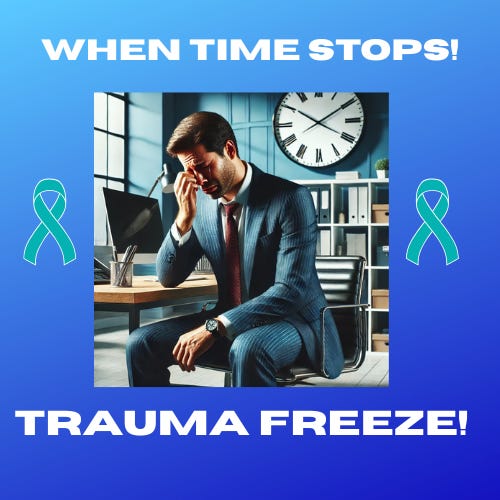
A 45-year-old executive gets worked up over a petty criticism from his boss and cries out in the bathroom like a wounded child. He is a successful lawyer but is also powerless in meetings, choking with the panic he began to experience at age seven.
When his loving parent erupted at his messy room, he was startled by the anger that seemed to come from nowhere.
What is happening in these moments? Why do mature, accomplished adults begin suddenly to react to situations in the present with the same intensity they experienced when they were children?
The Invisible Timestamp
When overpowering experiences arrive before we can process them, a remarkable transformation in our nervous system occurs. The trauma doesn’t just fade into memory as a thing in the past. It instead freezes where it was, retaining all its initial intensity, fear, and confusion.
Imagine your emotional journey becoming your timeline. Most life experiences let you move on and grow in resilience and maturity. But trauma makes a kind of pocket in the timetable, a sealed chamber in which a younger version of you stays, still feeling that moment of overwhelm.
This younger component is unaware that decades have passed. It doesn’t have your adult wisdom, your resources, or your safety. When something echoes that first experience here in your present life, even in whispers, that sealed chamber opens, and all of a sudden, you are not responding to it the way the adult you are today. You are answering in the way that the child you were then did.
Why Does It Feel as Though Leadership Is Impossible Sometimes
This really crops up in our professional lives and in the realm of leadership and authority.
If you felt trauma to yourself as a child, criticism that felt like a gut punch, punishment that felt like impending destruction, or expectations that you couldn’t possibly live up to, your nervous system taught you that having visibility and power were threats.
Your younger self has learned incredibly successful survival mechanisms: minimize your size, please others, avoid confrontation, and don’t ask for anything you don’t need. You’ve been able to keep yourself safe by having these strategies on hand.
But now, when you’re ordered to take charge of a team, to pitch to executives, or to advocate for yourself, that younger part runs up with every bit of its initial fear.
You’ll encounter:
Physical feelings that appear out of proportion to this time – a pounding pulse, a coiled throat, shaking hands
Sudden changes in thought processes: a helpful colleague suddenly seems unsafe to the extent of a compelling desire to run off, wrestle, or freeze that has nothing to do with how the stakes of any given moment are
Internal voices that sound like the same criticism you heard decades ago
This is not a weakness. This isn’t immaturity. This is your nervous system working precisely as it was created to: shield you from what used to seem like a question of survival.
The Path That Doesn’t Work
Here’s what’s keeping people stuck: trying to think their way out of a nervous system response.
You can’t just logic yourself out of your trauma trigger. You can’t think your way out of fear. You cannot “just get over it” by sheer willpower.
Why? Because trauma lives in the body and the subcortical brain, the parts that take in threat and safety before conscious thought even comes into play. By the time you realize you are responding that way, your body’s nervous system has made up its mind and is prepared to answer.
Trying to correct this through cognitive processes alone is tantamount to trying to stop a fire alarm by shutting down a few things with a few calm thoughts. The alarm wasn’t broken; it was doing precisely what it was programmed to do.
What needs to take place is to change the programming.
A Different Way: Working with the Younger You
Real healing happens when we tend toward these younger parts with compassion and curiosity rather than seeking to clear them up or override them.
First, pay attention to the arousal without judgment. If you sense you are reacting with unintended intensity, stop. Lay a hand on your chest or belly. Take a slow breath. Just this one thing starts to flag safety onto your nervous system.
Second, interest in how old the response is. Consider: “How old do I feel at this moment? Typically, individuals may immediately sense the age or stage to which their feelings correspond, such as identifying with an eight-year-old’s perspective or recalling emotions experienced during middle school. This is not imagination; it is your adult self, starting to discover which and what younger part is invoked.
Third, take a moment to say what that younger part needed then but didn’t get. Perhaps they needed someone to tell them, “You’re safe. You didn’t do anything wrong.” Maybe they require protection or the right to rest, a little light reassurance that they were enough. Now, from your adult self to your younger self, you can provide this.
Fourth, and this is vitally important, the younger part understands that time has gone by. Slowly guide them to the present: “We’re not seven anymore. We’re in our own home now. That person who hurt us isn’t here. We have choices now that we didn’t have then.”
This is not about positivity; this is not about affirmations and thoughts. It concerns helping ensure your nervous system updates its threat assessment with precise, present-moment information.
Conflict Without Catastrophe
One of the most meaningful changes that occurs through this work is the realization that conflict does not equal catastrophe.
A conflict for you at a young age could have been emotional abandonment, oppression, or an impending doom. Your nervous system learned: “Disagreement = risk to survival.” So now even a suggestion of tension with another person elicits the same survival response.
But here’s the thing that shifts as you’re doing this work: You start to realize that your adult self manages conflict with a stability your younger self never had. You can disagree with someone and still be fundamentally okay. You can let someone down and survive it. You know you can draw a line and put up with the hurt and the pain.
That is not to say conflict becomes easy or comfortable. It means it becomes possible.
You acquire what we might refer to as “dual awareness”: the capacity to notice when your younger self is getting activated and, at the same time, retain your connection to your adult resources. The fear is real, you know, and it’s not too bad. You can feel the desire to bolt and remain present. You can read the people-pleasing impulse and yet still respect your own needs.
The Gift of Inner Peace
Here’s what many folks don’t discover until they’ve done this work: the end goal isn’t to rid yourself of the younger parts. The idea is to form other bonds with them.
Once your younger parts don’t have to yell to get your attention, and they trust that you, the adult, will see their distress and act with sensitivity, something extraordinary happens.
They relax. They don’t need to commandeer your nervous system with significant reactions because they know you pay attention.
This opens space for what may be called nothing more than peace. Not the lack of feeling, but a deeper settledness. A feeling that even when life gets hard to live with, you have feet on the pavement.
You come to live with less fear of the emotional ambushes that follow. You quit stressing about controlling everything to keep the situation from activating. You gain a quiet confidence in yourself that even if you do get activated, you know how to return to yourself.
This peace isn’t fragile. It doesn’t depend on perfect conditions or the absence of stress. It resides within you, open even on the hardest days, because you’ve figured out how to stay with every one of all parts of yourself, the wounded and the wise, the young and the grown.
An Invitation to Healing
If you can see yourself in these pages, if you find yourself responding with an intensity unexpected of you, whether it’s standing silent when you wish to speak or avoiding encounters that are safe to your rational soul, know this: you are not broken.
Your nervous system is showing you the places where healing is needed. Those strong reactions are invitations to walk back toward the younger parts of yourself with the care they’ve always demanded.
This work is not about “fixing” yourself or making you someone else. The work is to welcome whatever parts of you are not fully healed, including those with pain that you left at the door of the past, and to help guide them back to where they belong now, a place where you have resources you never had then.
You can be piqued and still react with wisdom. You can be young and sensitive and still be a strong adult. You can honor your past while creating a different future.
That is the path: not away from the parts that have been wounded but through them on to a complete and wholesome being with everything you have encountered and everything you are becoming.
It is not easy, and it isn’t fast; moving from mere emotional reactivity to mature responsiveness is not a straight line. But it is possible. And it starts with a fundamental, revolutionary act: turning on yourself and looking at yourself with curiosity and compassion, rather than judgment and shame.
© 2025 www.soundthetrumpet.org

Written by