
The Culture Is in Chaos and Decline.
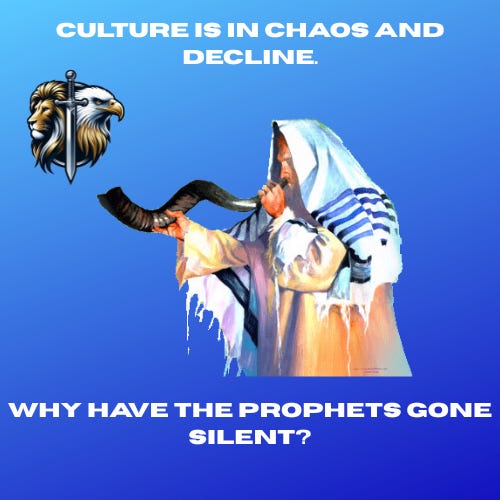
This Is the Hour for Prophetic Revelation.
What happens to a nation when its watchmen fall asleep?
What happens when the voices that once called people back from the edge go silent, replaced by the hum of entertainment, the noise of outrage, and the endless scroll of distraction? We are living in that moment now.
The prophetic voice, the one that cuts through comfort and convenience to speak what must be spoken, has grown faint. This is not because God has ceased to speak, but rather because we have ceased to listen. Worse still, those who are called to speak have learned that it’s easier to remain silent.
I sat across from a man in his fifties, once a leader in his community. He told me that he used to experience a burning sensation in his chest when he witnessed injustice and the trampled truth. He would speak up at city council meetings.
He would confront sin in his circles, even when it cost him friendships. But somewhere along the way, he said, the fire went out. He grew tired of being the one who made people uncomfortable, tired of being called judgmental. Tired of standing alone while others sat silent, waiting to see which way the wind would blow.
“I just don’t have the energy anymore,” he said. “And honestly, I’m not sure it matters. People believe what they want to believe.”
That conversation haunts me because I have heard versions of it dozens of times. From pastors. From teachers. From business leaders. From parents. People who once carried a word from God now carry only exhaustion and doubt.
The prophet Jeremiah described it this way: “My people have committed two evils: they have forsaken me, the fountain of living waters, and hewed out cisterns for themselves, broken cisterns that can hold no water” (Jeremiah 2:13, ESV).
We have traded the living voice of God for broken systems of our making. We drink from wells that cannot satisfy, and we wonder why we are so thirsty.
The Crisis of Silence
The absence of prophetic voices is not simply a religious problem. It is a cultural emergency. When there is a lack of prophetic voices, the void is filled with lies. When no one confronts evil, it becomes normal. When righteousness is mocked and compromise celebrated, the moral foundation of a society crumbles.
The prophet Isaiah warned, “Woe to those who call evil good and good evil, who put darkness for light and light for darkness, who put bitter for sweet and sweet for bitter!” (Isaiah 5:20, ESV).
We are living in that inversion. What was once shameful is now celebrated. What was once honorable is now dismissed as outdated. And those who dare to say otherwise are silenced, not by force, but by the social cost of standing apart.
The psychological weight of this moment is crushing. People know something is wrong. They sense the chaos. But they have been conditioned to distrust their discernment. They live in echo chambers that reinforce whatever narrative feels safest, whatever identity seems most acceptable. The wisdom of man, slick, polished, appealing to our sense of autonomy, has replaced the wisdom of God, which often comes wrapped in discomfort and the demand for change.
“There is a way that seems right to a man, but its end is the way to death” (Proverbs 14:12, ESV).
The Anatomy of Prophetic Silence
Why have the prophets gone silent and capitulated to the pressure of wanting to be accepted? It’s not because God has withdrawn His Spirit. The problem lies with us.
First, we have become dull at hearing.
Jesus quoted Isaiah when He said, “For this people’s heart has grown dull, and with their ears they can barely hear, and their eyes they have closed” (Matthew 13:15, ESV).
The constant barrage of information, opinion, and distraction has numbed our spiritual senses. We no longer recognize the voice of God when it speaks because we are too busy listening to a thousand other voices.
Second, we have elevated comfort over conviction. The prophetic word is rarely comfortable. It calls us out of our patterns, confronts our compromises, and demands transformation. But we have built lives centered on avoiding discomfort. We curate our experiences, surround ourselves with people who agree with us, and dismiss anyone who challenges us as divisive or unloving.
Third, we have confused popularity with anointing. True prophets have never been popular. Jeremiah was thrown into a cistern. Elijah ran for his life. John the Baptist lost his head.
Yet in our age, we measure spiritual authority by followers, likes, and book sales. We have created a celebrity culture in the church that mirrors the world’s obsession with image and influence. The result? The messages are crafted with the intention of pleasing rather than piercing. The words were intended to calm rather than to rescue.
The Anecdote That Changed Everything
Three years ago, I found myself in a small diner at 11 p.m., unable to sleep, wrestling with whether I still had anything to say. I had been writing and speaking for years, but it felt increasingly pointless, the same sins, the same patterns, the same empty responses. I was ready to walk away.
An older woman sat down in the booth across from me without asking. She looked weathered, hands calloused, and eyes sharp. She said, “You’re about to quit, aren’t you?”
I didn’t know her. I asked how she knew.
“Because I almost did too,” she said. “Thirty years ago. I was a teacher. Saw what was happening in the schools: lies being taught, truth being banned. I spoke up once and nearly lost my job. Therefore, I stayed quiet for ten years. Ten years. Then one day, a former student found me. She was wrecked. Destroyed by the lies she’d been taught. And she looked at me and said, ‘Why didn’t you warn us?’”
The woman leaned forward. “That question will haunt you more than any rejection ever could. They need the warning more than they need your silence.”
She left before I could respond. I never saw her again. But that encounter broke something open in me. The fear of speaking, of being rejected, of standing alone, suddenly seemed smaller than the weight of having nothing to say when the moment demanded it.
Prophets are not made in comfort. They are forged in crisis, in the place where silence becomes more unbearable than speech.
Four Steps to Reengaging the Prophetic Anointing
God has not silenced the prophetic voice. It has been silenced by fear, weariness, and the seduction of cultural acceptance. But it can be reawakened. Here is how:
Step One: Return to the Source
Before you can speak for God, you must hear from Him. The modern crisis is that we spend more time consuming content about God than encountering God Himself. Prophets are not formed in seminars or conferences. They are formed in the secret place, in the hours spent waiting, listening, and allowing God to burn away what is false.
“But they who wait for the Lord shall renew their strength; they shall mount up with wings like eagles; they shall run and not be weary; they shall walk and not faint.” (Isaiah 40:31, ESV).
Waiting is not passive. It is active surrender. It is the willingness to sit in silence until God speaks, rather than filling the silence with your own words. The prophetic anointing begins when you stop trying to manufacture a message and start receiving one.
Practically, this means turning off the noise. Set aside specific time, daily, not occasionally, to read Scripture without an agenda, to pray without a list, and to be before God. Let Him search you. Let Him confront you. Let Him shape the word He wants you to carry.
Step Two: Embrace the Cost
The prophetic calling has always carried a price.
Jeremiah lamented, “If I say, ‘I will not mention him, or speak any more in his name,’ there is in my heart as it were a burning fire shut up in my bones, and I am weary with holding it in, and I cannot” (Jeremiah 20:9, ESV).
You must settle this question: Are you willing to be misunderstood, rejected, and isolated for the sake of truth? If the answer is no, you will compromise every time the pressure comes. And the pressure will come.
The cost looks different for everyone. For some, it is social rejection. Others may face professional consequences. For many, it is the loss of comfort and predictability. But here is what I have learned: the cost of silence is always greater than the cost of speaking. Cowardice’s regret is more profound than the pain of obedience.
This topic is not about being reckless or harsh. Prophets speak with tears, not arrogance. They weep over the very sins they expose because they love the people they confront. But love does not stay silent when the house is on fire.
Step Three: Speak in Every Sphere
We have made a tragic mistake by limiting the prophetic voice to the pulpit. God is calling prophets into business, education, politics, medicine, media, and the arts. Every sphere of culture needs people who will speak truth, confront corruption, and model righteousness.
Daniel served in a pagan government. Joseph administered a secular economy. Esther influenced a foreign king. The prophetic anointing is not confined to religious spaces. It belongs wherever God’s people are positioned.
This means you do not have to be a pastor to carry a prophetic word. You demonstrate integrity in the boardroom by refusing to participate in dishonest practices. You carry it in the classroom when you teach truth despite pressure to conform. You can find it in your neighborhood when you stand up for what is right, even if it is unpopular.
“You are the salt of the earth, but if salt has lost its taste, how shall its saltiness be restored? It is no longer good for anything except to be thrown out and trampled under people’s feet” (Matthew 5:13, ESV).
Salt preserves and flavors. It does its work through contact. The prophetic voice must go where the decay is.
Step Four: Build Community, Not Platforms
One reason prophetic voices burn out is that they try to stand alone. God never intended that.
Elijah, who felt utterly isolated, was told there were seven thousand who had not bowed to Baal (1 Kings 19:18).
You need a community of people who will sharpen you, correct you, and encourage you. Not an audience. A community. People who know you, challenge you, and hold you accountable. People who will tell you when you are speaking from ego instead of anointing, when you are harsh instead of holy, and when you are more interested in being right than in seeing people restored.
The prophetic word is tested in the community. It is refined in a relationship. It is sustained by mutual encouragement.
“Iron sharpens iron, and one man sharpens another” (Proverbs 27:17, ESV).
Locate the others. They are out there, often weary, wondering if anyone else sees what they see. When prophets gather, not to build empires but to build each other up, the corporate anointing becomes unstoppable.
The Hour Demands It
We are living in a time when the prophetic voice is both most needed and most absent. Culture is not drifting. It is collapsing. The moral center is not holding. And into that void, someone must speak.
This must be done without resorting to mere condemnation. It should not be delivered with a sense of self-righteousness or superiority. Instead, it is characterized by a love that defies the temptation to allow individuals to destroy themselves. This is the kind of courage that continues to speak, even in the face of dry throats and trembling knees. The kind of faith that believes God’s word will accomplish its purpose, even when it seems no one is listening.
“So shall my word be that goes out from my mouth; it shall not return to me empty, but it shall accomplish that which I purpose, and shall succeed in the thing for which I sent it.” (Isaiah 55:11, ESV).
God is still speaking. The question is whether we will be the ones to carry His word into a generation that has forgotten how to hear it. The watchmen are needed. The prophets must rise. Not because we are special, but because the hour demands it and the Spirit enables it.
<I saw the man I spoke with six months later; he was the one who said the fire had gone out. He told me he had started talking again. Not perfectly. Not without fear. But he was speaking. And something had shifted. People were listening. Lives were changing. The fire, he said, had never really gone out. It had just been buried under too much fear.
“For God gave us a spirit not of fear but of power and love and self-control” (2 Timothy 1:7, ESV).
It is time to stop letting fear dictate our silence. It is time to return to the Source, embrace the cost, speak in every sphere, and build communities of prophetic witness. Culture is in chaos. This is the hour for prophetic revelation.
Where have all the prophets gone? They are waking up. They are remembering who they are. They are beginning to speak.
Will you be one of them?
©2025 www.soundthetrumpet.org

Written by