
As It Was in the Days of Jonah.

Could it be that He communicated with you through the very object of your worship?
Throughout history, He’s turned our idols into His messengers.
He transformed Pharaoh’s beloved Nile into blood.
He toppled Dagon before the ark.
And when an empire built on violence needed warning, He sent a prophet who looked exactly like their image of divine wisdom, a man emerging from the mouth of a fish.
The Assyrians saw their sacred story, embodied in flesh and bone, approaching them.
They had forty days to respond.
We might have less.
The God Who Speaks Through What We Worship
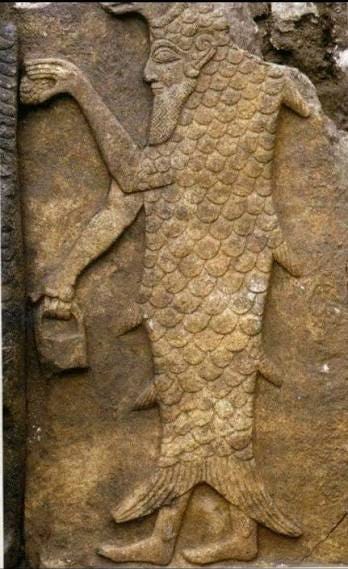
Oannes, the fish-cloaked sage, as symbols of divine wisdom.
~ God has never been subtle. God uses our idols as a megaphone to communicate His message. When Pharaoh trusted the Nile, God turned it to blood.
~ When the Philistines relied on Dagon, God put their god facedown before the ark.
~ When the Assyrians worshiped fish-cloaked sages as symbols of divine wisdom, God sent them a Hebrew prophet who spent three days inside an actual fish and emerged bleached and broken on their shore.
The pattern is deliberate: God speaks to nations in the language of their worship. He commandeers what we bow to and uses it to call us back.
This occurrence is not a coincidence. This is a strategy.
The apkallu were central to Assyrian religion; seven primordial sages were depicted as men wearing fish skins, the fish’s head draped over their own like a hood. The most famous, Oannes, was said to emerge from the sea each day to teach humanity divine wisdom, then return to the depths at night. These images covered palace walls. They stood guard at the city gates. They represented supernatural intervention, protection, and sacred knowledge from the abyss.
Then Jonah staggered out of the sea.
Jonah spent three days in the belly of a huge fish. These three days would echo through the centuries when Jesus declared, “For just as Jonah was three days and three nights in the belly of the enormous fish, so will the Son of Man be three days and three nights in the heart of the earth” (Matthew 12:40).
When Jonah emerged onto Nineveh’s shore, the Assyrians didn’t see a foreign prophet. They witnessed the embodiment of their mythology. Their sacred story walking. When he spoke, they heeded his words, as God had completely changed the course of events.
The sea creature wasn’t a rival deity or competing omen. It was an instrument of the living God, a public witness that the Lord rules the deep, commands creation, and can confront an empire’s idols without raising His voice.
Just by showing up.
When Violence Meets Mercy
The message was eight words in Hebrew: “Yet forty days, and Nineveh shall be overthrown!” (Jonah 3:4).
No explanation. No conditions. He simply announced the impending destruction.
And the most violent empire in the ancient world believed him.
These were not people prone to repentance. Assyrian kings commissioned artwork celebrating their brutality. They impaled captives. They burned cities. They skinned enemies alive and displayed the results as warnings. Their power was built on calculated terror, immortalized in stone reliefs that archaeologists still uncover today.
But when a man emerged from the sea looking like their prophecy of divine wisdom, they didn’t argue. They didn’t negotiate.
They repented.
“Then the people of Nineveh believed God. “From the greatest to the least, they called for a fast and put on sackcloth” (Jonah 3:5)
The king tore his robes, sat in ashes, and issued a decree: “Let everyone turn from his evil way and from the violence that is in his hands. Who knows? God may turn and relent and turn from his fierce anger, so that we may not perish” (Jonah 3:8-9).
He has the power to turn away from the violence that is in his hands.
Not theoretical violence. Not someone else’s violence. They had committed and celebrated the violence themselves. The king called the entire city to acknowledge what they had done and turn from it completely.
God saw their repentance and relented. “When God saw what they did, how they turned from their evil ways, God relented of the disaster that he had said he would do to them, and he did not do it” (Jonah 3:10).
The city was spared.
The Prophet Who Wanted Judgment
This is the pivotal moment in the story.
Jonah’s response to successful prophecy was rage. “But it displeased Jonah exceedingly, and he was angry” (Jonah 4:1).
He had paid the price. Three days in darkness. He endured three days of terror in the belly of the fish before transforming into a living sign. He delivered the message. They repented.
And he was furious.
His prayer reveals why: “O LORD, is not this what I said when I was yet in my country? That is why I made haste to flee to Tarshish; for I knew that you are a gracious God and merciful, slow to anger and abounding in steadfast love, and relenting from disaster” (Jonah 4:2).
Jonah knew God’s character from the beginning. He knew that if Nineveh repented, God would spare them. That’s precisely why he ran. He didn’t want mercy for the Assyrians. He wanted them destroyed.
They deserved it. Their violence was documented. Their cruelty was policy. Jonah wasn’t wrong about their guilt. He was wrong about what should happen to the guilty when they repent.
God’s response is a question: “Do you do well to be angry?” (Jonah 4:4).
Then God appointed a plant to shade Jonah, and a worm to destroy it, and a scorching wind to beat on his head. When Jonah wished for death over the loss of the plant, God asked again, “Do you do well to be angry for the plant?” (Jonah 4:9).
Jonah answered yes. Angry enough to die.
Then comes God’s final word: “And should not I pity Nineveh, that huge city, in which there are more than 120,000 persons who do not know their right hand from their left, and also many cattle?” (Jonah 4:11).
The book ends there. No resolution. The question remains unresolved, awaiting an answer that Jonah never provides.
The Sign We Still Need
Jesus said plainly that His generation would receive only one sign: “An evil and adulterous generation seeks for a sign, but no sign will be given to it except the sign of the prophet Jonah” (Matthew 12:39).
He spent three days in the grave. Emergence into resurrection. He made a final offer of repentance to those who believed they understood God.
The pattern hasn’t changed. God still speaks through what we worship. He still offers mercy to the violent. He still asks whether we want justice or redemption, knowing we cannot have both on our own terms.
What Does This Situation Mean for Us?
We live in America amid fracture and rage.
We have violence in our streets and in our speeches.
However, the most perilous actions often occur in private, rather than in public. There are leaders and forums that craft vengeance behind closed doors, then sell it as virtue.
They deceive the public using polished language, and when their persuasion fails, they unleash programmed warriors, agents of disruption trained to inflict harm, damage infrastructure, and hurt the public while labeling their actions as “necessary.” They do this to safeguard the liberties of the citizens, or so they say!
We are sure of the guilty and that we are not among them, as we have chosen a side and believe we are right.
We document each other’s failures with a precision like the Assyrians, who used to document their conquests, except we do it on phones and social media rather than stone reliefs.
Our prophets aren’t calling us to repentance.
They’re calling us to activism, reform, and ideological warfare. These may have their place, but they are not what Jonah preached. Jonah didn’t come with a plan to fix Nineveh. He came with a warning that time was running out.
So, here’s the question: What if God wanted to speak to us the way He spoke to Nineveh?
What if He wanted to use the very things we worship to deliver a word we cannot ignore?
And what if the Lord answered this hour through the Prince of Liberty, not as a slogan, not as a partisan chant, but as our Judge, exposing hidden agreements, unmasking wickedness done in secret, and confronting the lies we tolerate because they flatter our side?
Is our freedom real, or has its foundation been corrupted?
We worship ideology, bowing to political frameworks, convinced our side will save us.
We worship technology, trusting innovation to solve what character cannot.
We worship comfort, organizing entire lives around avoiding suffering.
We worship identity, finding worth in tribal categories instead of the image of God.
What if God raised a voice from within those systems?
What if someone emerged from the belly of our obsessions, marked by suffering we recognize, speaking truth we didn’t want to hear?
The Ninevites repented because Jonah came in a form they understood. He looked like their sacred story, in which they sought wisdom, had come true.
He spoke their language of divine intervention. And when he warned them, they believed.
We’re waiting for prophets we can dismiss, voices from the other side, or ones we can ignore, people whose suffering doesn’t touch us, or whose message fits too neatly into our existing battles.
But God sends the sign we will recognize if we’re willing to see it.
The Invitation to Turn
The king of Nineveh didn’t defend his record. He didn’t blame his advisors or point to external threats. He tore his robes, sat in ashes, and commanded the city, “Let everyone turn from his evil way and from the violence that is in his hands” (Jonah 3:8).
Everyone. Not the obviously guilty. Not the political opposition. Everyone.
That’s the repentance God honored. The kind that starts with personal acknowledgment of participation in what is broken. This type of repentance doesn’t wait for others to take the lead.
What would it look like if we responded the way Nineveh did?
We shouldn’t engage in arguments about who is more deserving of judgment. We should refrain from making calculations about who is more deserving of punishment. But honest turning begins with us.
“Let everyone turn from his evil way.”
From our evil. We must turn away from our own acts of violence, whether they are physical, verbal, or the cold indifference we display to suffering that doesn’t directly affect us.
The invitation is too fast. To sit in ashes. We need to express our visible grief over the disparity between the person God intended us to be and the person we have become. This is not a performance, but a genuine expression of grief.
The king said, “Who knows? God may turn and relent and turn from his fierce anger, so that we may not perish” (Jonah 3:9).
Not certainty. Hope. Hope grounded in God’s character: gracious and merciful, slow to anger, abounding in steadfast love.
Jonah hated that about God. He wanted clean lines between the righteous and the wicked. He wanted those who deserved judgment to receive it.
But God’s final question was about compassion: Do you understand that every person in that city is someone I love enough to warn?
We are those people now. We are a violent nation, convinced of our importance, operating on principles that look nothing like the kingdom of God. We are the ones who need a sign we will recognize and the humility to respond.
The word is simple: repent. Turn. Stop the things that are breaking us and grieving God. Stop trusting the systems we built and return to the God who built us.
It’s not complicated. It’s costly. It costs certainty. It costs tribal loyalty. It costs the right to blame everyone else while excusing ourselves.
But the alternative is what Jonah warned: forty days, then destruction.
Not because God is eager to judge, but because judgment is what remains when mercy is refused.
Nineveh repented and was spared. One generation later, they returned to violence. A century after Jonah, the prophet Nahum pronounced their final doom.
That time, there was no reprieve.
We choose which story we’re living.
A Beginning, Not an Ending
There is a path forward that doesn’t necessitate possessing all the answers beforehand.
It begins with what the Ninevites did: trusting the warning enough to act.
They didn’t wait for consensus or form committees to verify the prophet’s credentials.
They heard the message, believed it, and responded immediately.
If you’re reading this and sense that we’re living in a time of uncertainty, you don’t need permission to begin. You don’t need the entire nation to move before you do.
You can fast.
You can pray.
You can confess to God how you’ve contributed to the brokenness and violence, how you’ve condemned it in others while excusing it in yourself, and how you’ve disguised tribalism with religious language.
You can ask God to search your heart the way the king of Nineveh asked his people to search theirs. “Let everyone turn from his evil way and from the violence that is in his hands” (Jonah 3:8).
That turning can begin today, in the quiet place where only God sees. And if enough of us respond that way, who knows?
“God may turn and relent and turn from his fierce anger, so that we may not perish” (Jonah 3:9).
This is not naive optimism. It reflects what God does when people take Him seriously enough to repent. Nineveh proves it. The pattern is clear. Mercy is available.
The question is whether we want to humble ourselves enough to accept it.
This isn’t a call to political action, though your repentance might change how you engage politically. It’s not a call for public spectacle, though your transformation might eventually become visible. It’s a call for the private, often costly turning that leads to real revival in history.
It starts with individuals stopping their self-defense to listen clearly to God’s word. It continues with families choosing repentance over reputation. It spreads across communities that value mercy more than being proven right.
And it results in what happened in Nineveh: a nation spared because enough people believed the warning and turned before it was too late.
We still have time.
Not endless, but real-time.
We have sufficient time to react if we so choose.
The sign of Jonah stands before us.
The message is clear.
The mercy is offered. All that remains is our answer!
2025 (C) www.soundthetrumpet.org

Written by