
Are prophets and apostles really for today?
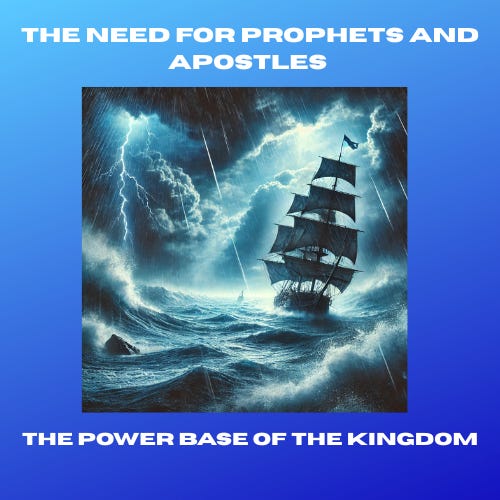
The Need for Prophets and Apostles
One of the quieter challenges facing the Church is not the absence of apostles, but the diminishing awareness of what their presence once carried. Apostles were never meant to be mere architects of structure; they were first listeners, men and women shaped by revelation, sent with clarity, and governed by obedience to the voice of God. Over time, we have learned how to build, organize, and expand the work of the Kingdom with growing skill, yet often with less attentiveness to the revelatory foundation that once guided apostolic influence. What we call maturity may, at times, be a shift from dependence to management. And beneath the activity, a gentle question invites us to reflect: what part of the apostolic grace have we allowed to fade?
The ship is taking on water. But we are too busy rearranging the deck chairs to notice.
The Centurion chose to listen to the Pilot rather than the Prisoner.
In Acts 27, Paul stood in the belly of a ship bound for Rome, a prisoner in chains. The Fair Havens harbor was behind them, and the sailing season was already dangerous. Paul spoke with the authority that came not from his station but from his office:
“Men, I perceive that the voyage will be with injury and much loss, not only of the cargo and the ship, but also of our lives” (Acts 27:10, ESV).
The centurion had a choice. He could listen to the prisoner who carried apostolic grace, or he could listen to the pilot and the owner of the ship, men whose credentials were impeccable by worldly standards. He chose the latter.
“The centurion paid more attention to the pilot and to the owner of the ship than to what Paul said” (Acts 27:11, ESV).
What followed was predictable. A tempestuous wind called Euraquilo swept down, and for fourteen days they saw neither sun nor stars. They threw cargo overboard, then tackle, then hope. The ship finally ran aground on the island of Malta, breaking apart in the surf. They survived only because Paul had already told them they would, speaking again with authority in the storm’s darkest hour.
The point is, Paul’s chains did not diminish his calling. His imprisonment did not revoke his office. He was still an apostle and still carried the discernment and authority of one sent by Christ, and the centurion’s failure to recognize that authority nearly cost everyone their lives.
The same pattern persists today.
The Famine in the Land
Amos spoke of a coming famine, “not a famine of bread, nor a thirst for water, but of hearing the words of the Lord” (Amos 8:11, ESV).
That famine has arrived, and it sits in our pews. We have teaching, endless teaching. Podcasts, conferences, and books abound. But we lack the Lord’s clear, weighty word from those who have been with Him.
The apostolic and prophetic offices are not optional accessories to the church. They are foundational.
Paul wrote to the Ephesians that Christ “gave the apostles, the prophets, the evangelists, the shepherds, and the teachers to equip the saints for the work of ministry, for building up the body of Christ” (Ephesians 4:11-12, ESV).
These are not ancient relics. These are present-tense gifts, given until we “all attain to the unity of the faith and of the knowledge of the Son of God, to mature manhood, to the measure of the stature of the fullness of Christ” (Ephesians 4:13, ESV).
We have not arrived. We are not mature. We are still tossed by waves and carried about by every wind of doctrine. We need apostles and prophets because the alternative is chaos.
The Power Base of the Kingdom
The kingdom of God does not operate on democratic principles. It is not a republic where every voice carries equal weight, nor is it a corporation where the board can outvote the founder. The kingdom operates on divine order, with Christ as King and delegated authority flowing through offices He established.
When Paul wrote that the church is “built on the foundation of the apostles and prophets, Christ Jesus himself being the cornerstone” (Ephesians 2:20, ESV), he was not speaking metaphorically about the past. He was establishing the structure by which the church would function across generations. Apostles lay foundations. They pioneer. They establish order where there was none, truth where there was confusion, and the rule of Christ where chaos previously reigned. Prophets bring the immediate, specific word of God, cutting through human wisdom to reveal His heart and intention.
Together, these offices form the power base of kingdom advance. Without them, the church becomes self-referential, talking to itself about itself, mistaking activity for fruitfulness and noise for revival.
The Corinthian church was filled with spiritual gifts but lacked proper order. Paul had to remind them, “God is not a God of confusion but of peace” (1 Corinthians 14:33, ESV). He had to correct their misuse of tongues, their disorder in worship, and their arrogance about knowledge. They needed an apostle to set things right. They could not correct themselves because they lacked the perspective and authority to do so.
This story is still true. Churches today can be biblically informed and spiritually dead. They can be doctrinally sound and relationally toxic. They can be growing in numbers while shrinking in power. The presence of teaching alone does not produce maturity. We need the full complement of ministry gifts, especially those that have been most neglected: apostles who establish foundations and prophets who speak the word of the Lord.
What are the consequences of rejecting these offices??
The centurion chose the pilot over the apostle, and the ship went down. The pattern repeats in countless forms. Pastors burn out because they are asked to carry weights they were never designed to bear. Churches split because there is no higher authority to appeal to, no apostolic wisdom to bring clarity. Believers roam from conference to conference, book to book, and podcast to podcast, seeking something they can’t name: not information, but impartation; not another sermon, but a prophetic word that pierces through the fog.
We now respect past offices but reject current ones. We quote Paul with reverence but would question any modern apostle with suspicion. We study the prophets of old but grow nervous when someone speaks with prophetic authority today. Such thinking is not wisdom. This is unbelief dressed in caution.
Jesus did not distribute these gifts only to the first-century church. He gave these gifts to the church. The phrase “He gave” is in the aorist tense, indicating a completed action that has ongoing results. The gift was given once and remains in effect. To say we no longer need apostles and prophets is to say we have outgrown Christ’s provision, that we know better than He does what His body requires.
The Call to Recognize and Restore
Paul stood in chains and spoke the truth that the centurion refused to hear. But notice this: Paul continued as an apostle, even though he was not recognized as one. His authority was not contingent on the centurion’s acknowledgment. It simply would have been better for everyone if the centurion had listened.
The church does not need to manufacture apostles and prophets. God raises them. What the church needs to do is recognize them, honor them, and submit to the grace they carry. Such obedience requires humility. It requires discernment. It requires a willingness to be corrected by voices that may not fit our expectations or comfort our preferences.
There are men and women today who carry apostolic and prophetic grace. They are not always the loudest voices or the most popular. Like Paul, they may be bound by circumstances that seem to disqualify them in the eyes of the world. But their office remains, and the word they carry is accurate.
The question is, will we listen?
The storm is already upon us. The wind is picking up, and the stars are hidden. We can continue to trust the pilots and owners, the experts whose credentials are impressive but whose discernment is limited. Or we can turn our ears toward those who, however unlikely their station, carry the word of the Lord.
The ship might still encounter difficulties. God’s word through Paul promised survival, not comfort. However, there is a significant distinction between failing to follow divine guidance and failing to listen.
The church was never meant to sail these waters without apostolic and prophetic guidance. We have attempted it, and the consequences are evident. We must restore what we neglected, honor what we dismissed, and listen to the voices we were too proud or afraid to hear. The kingdom requires its whole structure to advance. Christ knew this when He gave these gifts.
The question is whether we will acknowledge it.
~ SELAH
https://soundthetrumpet.org/books/prophetic-code
© www.soundthetrumpet.org

Written by