
Are You Connected… or Emotionally Trapped?
A Story You May Recognize
My friend James, a veteran, told me he could not make a single decision without calling his girlfriend first. Not big decisions. Any decision.
When his girlfriend became ill and unable to instruct him for three months as she recovered, this capable, decorated veteran froze.
Projects stalled. His buddies noticed. His family noticed. He described it this way:
“I realized I had outsourced my mind to another person, and when the line went dead, so did I.”
He was not weak. He was enmeshed. And he never saw it coming, because it started as something good. Admiration. Loyalty. Trust. Somewhere along the way, healthy connection quietly became unhealthy fusion.
When Love Becomes a Leash
You feel it before you can name it.
The tightness in your chest when their name appears on your phone. The way your mood rises and falls with their approval. The exhaustion of managing someone else’s emotions as if they were your own. The quiet fear that if you say no, if you set a boundary, if you disappoint them once, everything collapses.
You tell yourself this is love. Loyalty. Commitment. Ministry. Family. Duty.
But deep down, a question keeps surfacing: why does this relationship feel less like a covenant and more like captivity?
Enmeshment is dependency wearing the mask of devotion. It looks like closeness, but it functions as control. It promises security, but it delivers anxiety. And here is the hard truth many of us avoid: we are often not victims of enmeshment.
We are participants in it. We handed someone the keys to our identity because it felt safer than carrying our own.
Scripture calls this what it is. “Cursed is the man who trusts in mankind and makes flesh his strength” (Jeremiah 17:5, NASB).
Not because people are evil, but because people were never designed to bear the weight of being your source.
The Real Problem Beneath the Surface
Most people misunderstand enmeshment, confusing it with intimacy.
Intimacy is two whole people choosing each other. Enmeshment is two incomplete people using each other. In intimacy, you can disagree and stay connected. In enmeshment, disagreement feels like abandonment.
In intimacy, boundaries are respected. In enmeshment, boundaries are seen as betrayal. The real issue is not the other person. It is a displaced source.
Jeremiah named it with devastating precision: “For My people have committed two evils: They have abandoned Me, the fountain of living waters, to carve out for themselves cisterns, broken cisterns that do not hold water” (Jeremiah 2:13, NASB).
A broken cistern is anything you draw life from that cannot sustain you. A mentor. A spouse. A ministry. A title. A parent’s approval. A cistern is not always sinful. It is simply insufficient. And when you keep drawing from an empty well, you do not just stay thirsty. You slowly come to believe that thirst is normal.
Ask yourself honestly: what specific behaviors make your dependency feel unhealthy? Is it the inability to decide without them? The panic when they pull away?
The resentment you swallow to keep the peace? Name the behavior. Naming is the beginning of freedom.
What Enmeshment Does to You
Enmeshment is not just a relational problem. It rewires you.
Mentally, it erodes your judgment. Neuroscience shows that chronic relational anxiety keeps the amygdala on high alert, suppressing the prefrontal cortex, the very region responsible for clear thinking and wise decisions. You literally think less clearly when your nervous system is fused to someone else’s moods.
Emotionally, it creates a counterfeit identity. You become an expert on their feelings and a stranger to your own. Ask an enmeshed person what they want and watch them hesitate. They have spent years wanting what keeps the other person calm.
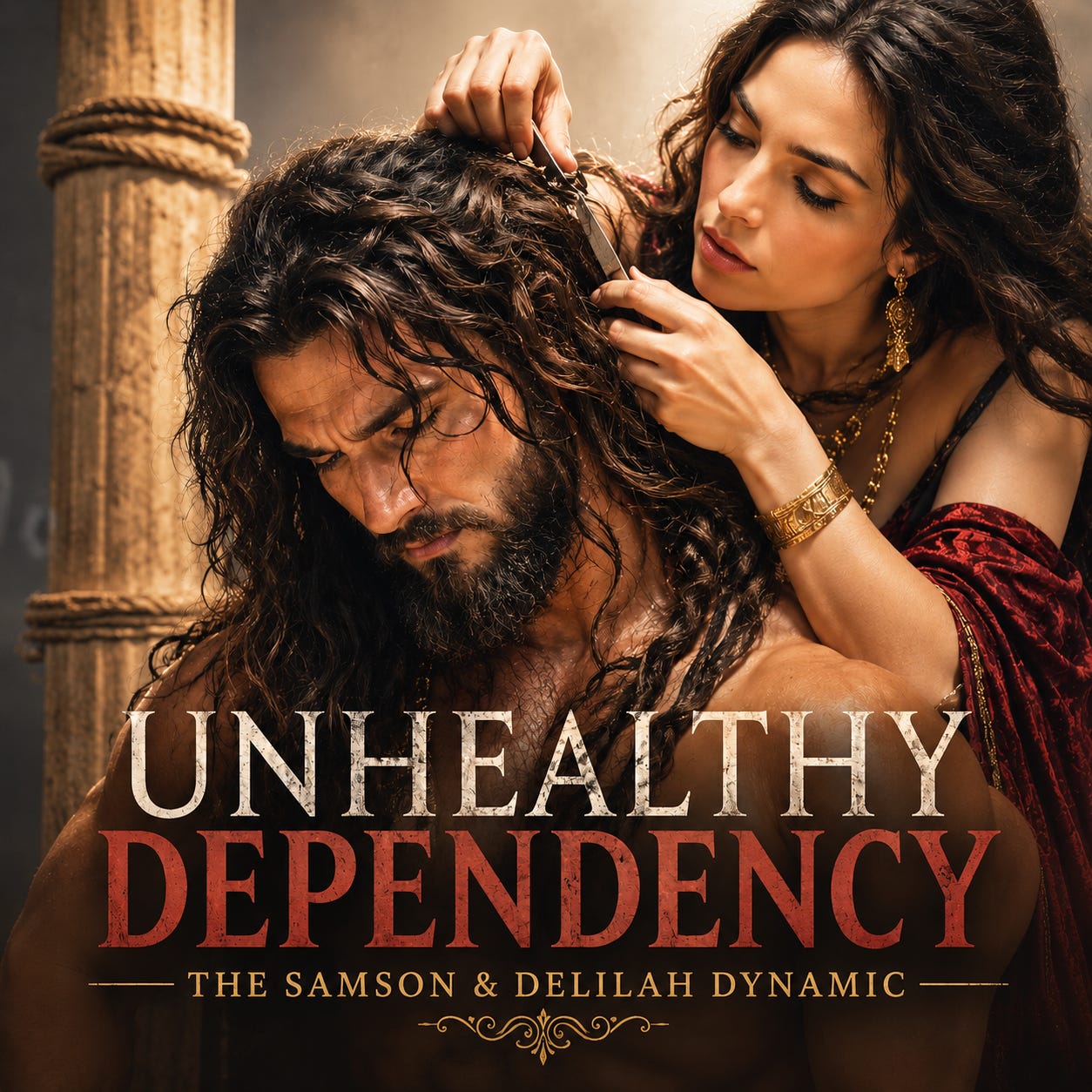
Spiritually, it becomes idolatry with good manners. Samson’s story in Judges 16 is the portrait. A man of extraordinary calling laid his head in Delilah’s lap and told her the secret of his strength, even after she had betrayed him three times.
Read that again. Three times she tried to destroy him, and he stayed. That is not love. That is enmeshment. The result: “he did not know that the Lord had departed from him” (Judges 16:20, NASB).
Enmeshment dulls discernment until you cannot tell the difference between presence and absence, between anointing and adrenaline.
Relationally, it breeds rivalry and resentment. Look at Rachel and Leah in Genesis 29 and 30. Leah kept bearing sons, hoping each child would finally win Jacob’s heart:
“Now this time my husband will become attached to me” (Genesis 29:34, NASB).
Rachel, desperate, cried to Jacob, “Give me children, or else I am going to die” (Genesis 30:1, NASB).
Two women, one demanding life from a husband, the other demanding love from him. Both drew from a man what only God could give. The household became a battlefield.
In leadership, influence can turn into insecurity.
King Saul heard the women sing, “Saul has slain his thousands, and David his ten thousand” (1 Samuel 18:7, NASB), and Scripture says, “Saul looked at David with suspicion from that day on” (1 Samuel 18:9, NASB).
Saul’s identity was enmeshed in public approval. When the applause shifted, so did his sanity. A leader whose worth depends on the crowd will eventually throw spears at the very people God sent to help him. The Biblical Diagnosis and the Divine Alternative
Here is the spiritual center of this whole issue.
“The fear of man brings a snare, but one who trusts in the Lord will be protected” (Proverbs 29:25, NASB).
Notice the word snare. A snare does not announce itself. It hides in ordinary ground. You do not walk into enmeshment. You drift into it, one small surrender of self at a time. One unspoken need. One boundary you did not defend. One approval you could not live without.
The biblical solution is not independence. Scripture never celebrates the lone wolf. The solution is to transfer dependency: shifting your source from man-dependency to God-dependency.
“For we are His workmanship, created in Christ Jesus for good works, which God prepared beforehand so that we would walk in them” (Ephesians 2:10, NASB).
Your identity was authored before your relationships existed. No person gave it to you, and no person can take it from you.
David understood this. While Saul unraveled, David declared, “My soul, wait in silence for God alone, for my hope is from Him. He alone is my rock and my salvation, my refuge; I will not be shaken” (Psalm 62:5-6, NASB).
The word alone is the whole battle. Not God plus their approval. Not God plus that relationship. God alone as source, so that people can return to being gifts.
Renewing the Mind, Step by Step
“Be transformed by the renewing of your mind” (Romans 12:2, NASB).
Renewal is not a moment. It is a practice. Here are five steps you can begin today.
Step 1: Name the fusion. Write down the specific behaviors that feel unhealthy. Do you rehearse conversations to avoid their displeasure? Feel guilt when you rest? Cannot decide without their sign-off? What you can name, you can address. What stays vague stays in charge.
Step 2: Separate love from source. Each morning, before you check your phone, pray this: “Lord, You alone are my source. People are gifts, not gods.” Repetition rewires. This is both neuroscience and discipleship.
Step 3: Practice one small boundary. Not a dramatic confrontation. One honest sentence. “I need to pray about that before I answer.” “I disagree, and I still love you.” Boundaries are not walls against people. They are definitions of where you end, and God begins.
Step 4: Sit with the discomfort. When you stop over-functioning for others, expect anxiety. That anxiety is withdrawal, not warning. Let the discomfort drive you to the Fountain instead of back to the cistern. “Cast your burden upon the Lord, and He will sustain you” (Psalm 55:22, NASB).
Step 5: Rebuild identity at the root. Spend time daily in Scripture that defines you before anyone else does. Ephesians 1 and 2. Psalm 139. Let God’s voice become the loudest voice in your inner world.
The Courage to Come Home.
Samson’s story does not end at the mill.
Blind and bound, “the hair of his head began to grow again” (Judges 16:22, NASB). His final prayer was not to Delilah.
It was to God: “Lord God, please remember me and please strengthen me just this time” (Judges 16:28, NASB).
Even after devastating enmeshment, the way back was the same as it always was. Return to the Source.
That is your invitation too.
You are not being asked to abandon people. You are being asked to release them from a role they were never meant to play. Take your identity out of their hands and place it back into the hands that formed you.
Here is your one meaningful step: identify the single relationship where you feel most fused, and this week, take one boundary, one honest sentence, one prayer of transfer. “God, You alone are my source.”
The chains of enmeshment rarely break all at once.
But they always break the same way. One returned dependency at a time.
Your hair is growing back. Come home!
~SELAH
2026 © www.soundthetrumpet.org